
It Never Makes Sense
The US market is back at all-time highs. It fell just under 10% in response to the Iran war and has since recovered all those losses.
I am hearing from a lot of people that markets make no sense. How can we have war and an unstable political climate and markets at all time highs? It feels like the market should still be down.
It Just.Doesn’t.Make.Sense.
One of the biggest mistakes you will ever make as investor is trying to make sense of the short-term movements of markets.
The stock market doesn’t act on feelings. It doesn’t care what you think or what you want it to do.

Here’s the thing. The market is a forward-looking expectation machine. It doesn’t reflect what is happening today. It reflects collective anticipations about the future. It cares about the future earnings that are going to be generated by the businesses that make up the market. And right now, we are in a period of extremely strong earnings growth.
In the long-run, share prices go up because earnings go up. They act rationally. In the short-run they are anything but rational.
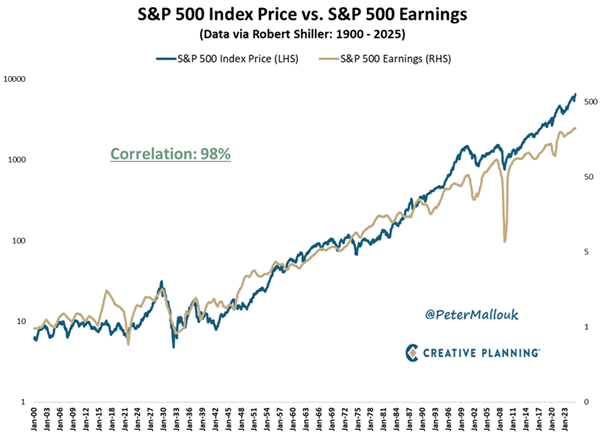
There is an almost 100% correlationn between the long-run movement of markets and earnings.
Let’s go back in time to two previous and painful market bottoms to try and ‘make sense’ of what is going on today – the financial crisis and COVID.
During the financial crisis the S&P 500 fell 57% between October 2007 and March 2009. It bottomed on 9th March 2007 at a price of 676. Less than 20 years later the price is 7200.
It’s worth remembering what was going on in March 2009 when the market bottomed at 676.
It was still really really bad out there.
In April 2009 George Soros claimed that US bank were ‘basically insolvent’. In May 2009 Chrysler filed for bankruptcy. In June 2009 General Motors filed for bankruptcy. In January 2010 foreclosures in the US hit a record high.
The market didn’t care about any of that. It had discounted all of that and things, whilst still really bad, were not as bad as they had been. So that market went up. And it never looked back.
And what about the COVID bottom? The market fell 34% in the six weeks from 29th February 2020. When it bottomed in March 2020 we were still deep in the pandemic. Three billion people worldwide – almost one-third of the global population – were under some form of lockdown or stay-at-home order. The vaccine was not approved by the FDA until December 2020. The lockdowns continued in many countries for months – the UK, for example, was back in lockdown in 2021.
Justin Wolfers explained this recently – markets rise when things are better than expected – not when things are good. “Wall Street is basically my mum with a report card: expected a D, got a C, called it progress.”
Back to where we are currently; the Iran war is far from over and it’s debatable whether things have got better, but the market has bottomed.
We can only see the bottoms in hindsight. No one rings a bell at the bottom. Or the top. Hindsight is a glorious thing.
The famous trader, Jesse Livermore, who at one point was considered one of the richest traders in the world, once said:
“The stock market is never obvious. It is designed to fool most of the people, most of the time.”
In the end, it fooled him too many times and his life was a series of tragedies. He went bankrupt at least three times, building back his wealth from scratch each time. His life of speculation was too much and he committed suicide in a New York hotel at 63 years old.
So don’t try and make sense of it. You will never make sense of it in the short-term. You will drive yourself crazy trying!
Do the best thing you can – get in and stay in.
As I always say, short-term irrational, long-term rational.
Or in the words of John Maynard Keynes
“The market can stay irrational longer than you can stay solvent.”
Georgie
georgie@libertywealth.ky