
Risk, In Real Life
We have lived in Cayman for 20 years. We are now spending a bit more time back in the UK because our kids have started school here. We have a foot in both worlds, which has its positives and negatives for sure. Regular long-haul flights can take a toll, but living in two different places is a privileged position to be in and every day I think how lucky we, and our kids, are.
Parenting is about changes and transitions. And this is one of the transition periods. We won’t be doing this forever – it’s just a phase. We will blink and our kids will have finished school and be off to university.
Over the years that we have been away from the UK people have often asked ‘what do you miss?’ My obvious answer is family. We built a life 5,000 miles away from family and you pay a price for that. We have missed many family celebrations along the way and it doesn’t get easier.
We have been back to the UK every year, sometimes twice a year, but until recently the most time we have spent in the UK in one go is probably two weeks. Now we have a home here (my first home in the UK) and feel a bit more rooted. I have been thinking about what I have missed and what it is that makes the UK so special (in my opinion).
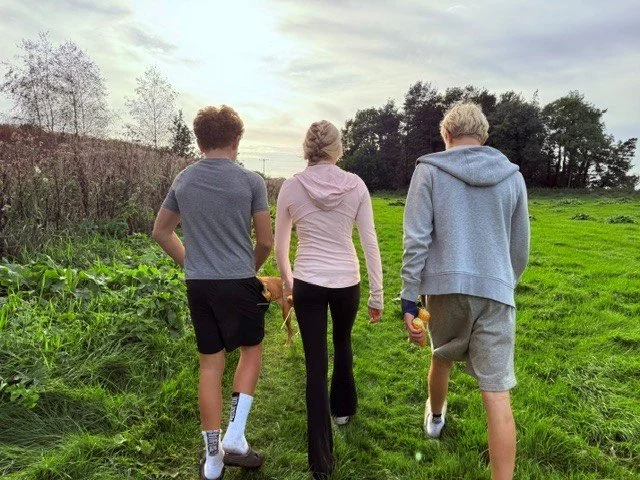
I have missed the countryside – the variety of the countryside. I have missed going for a walk – a good old stomp through the fields and woods. Although I don’t like being cold, I have missed wrapping up warm – jeans and jumpers and that cosy feeling. I have missed both the long summer days and the short winter days. I have missed the changing of the seasons – the joy of the first buds in spring and the changing colours of autumn.
Our house is in a village and we have a quintessential English pub just down our road. When my parents were visiting recently we pootled down for a Sunday evening drink, around 6pm. The bar was packed with locals and their dogs (there are a lot more dogs in the UK than I remember). We had a glass of wine and a pack of crisps. It was so nostalgic and I really struggled to think of any place quite like a good old English pub.
As Gen Z would say, it’s a vibe.
I have missed the weekend papers. I have really missed the weekend papers in the pub. Or in the living room, by the fire.
When we first arrived in Cayman in 2006 there was a company that would print the paper and deliver it to your door. It stopped after a few years. It’s been at least 18 years since I have really had a chance to sit and read the paper.
It’s one of life’s little joys.
Last weekend I bought four – I am still figuring out which I like. The Times, FT, The Observer and The Guardian – all are contenders.
One thing I couldn’t fail to notice was the price. I purchased The Sunday Times from our local newsagent for £4.50. I remember paying £1 when I lived in London 20 years ago. That’s 7.8% inflation per year.
After a little research I discovered that newspapers were in a price war 20 years ago so the price back then was arguably artificially low. But still.
That’s a hefty price rise.
This got me thinking about something I talk to clients about every week.
Another joy is being able to walk into our village and pop to the post office – it’s one of those ‘we have everything’ post offices. When I went to post a letter in our local post office I was surprised that it cost £1.80 for a first-class stamp.
In 2006, when I left, a first-class stamp cost 32p.
That’s an inflation rate of 9% per year.
Buying a drink in our local pub is cheap compared to buying a drink in Cayman (everything is cheap compared to Cayman) but it is still double what it was when we left 20 years ago.
That’s a pretty normal state of affairs, prices doubling over a twenty-year period. My examples of the weekend papers and the price of a stamp are a bit unfair as they have both gone up at far more than the average rate of inflation. 9% inflation means prices double in 8 years.
And here’s the thing.
If this twenty-year period had been my retirement, rising prices would have been my biggest risk.
Rising prices are always your risk. But particularly so during retirement.
As they approach retirement most people move from higher volatility investments (equities) to lower volatility investments (bonds).
For a lot of people this is a huge mistake.
Bonds, in general, give a fixed income – they are a debt instrument. When you buy a bond you lend money to something (normally a company or a government) for a certain period of time – in return that ‘something’ gives you a fixed income or ‘yield’ and then gives you your money back at the end of the ‘term’.
Let’s say, you lend money to Apple, that is, you buy an Apple bond. This bond has a 20-year term and a 5% yield. You lend Apple $1m and they return the favour by giving you a 5% yield – you will get $50,000 a year as income (I am simplifying this).
Here’s the problem though. In 20 years that bond is still giving you $50,000 of income.
And, on top of that, when Apple hands your $1m back after 20 years, if prices have doubled, your $1m will only buy what $500,000 does today. Your purchasing power has halved.
During the 20 years that I have been away from the UK, the price of the weekend papers has gone up by 4.5 times, a stamp has gone up by 5.6 times and a glass of wine has doubled.
This is the risk, in real life. Most people think volatility is the big risk. For a retiree, inflation is often the bigger one. In retirement, you need your income to grow at least at the rate at which the cost of living is going up. Otherwise, you find yourself going backwards.
In Hemingway’s ‘The Sun Also Rises’, a character is asked how he went bankrupt. ‘Two ways’, he replies. ‘Gradually, then suddenly’.
That is how inflation works.
We have seen a wave of people recently who are close to retirement or just retired. They have wealth but absolutely no idea how to turn that into a growing income that will enable them to live, stress-free, for the rest of their lives...and beyond.
If that’s you, get in touch, because building portfolios that protect not only income but also legacy is what we do.
Remember, there is no such thing as no risk. There is always risk. It’s just a question of what you want to risk and when you want to risk it.